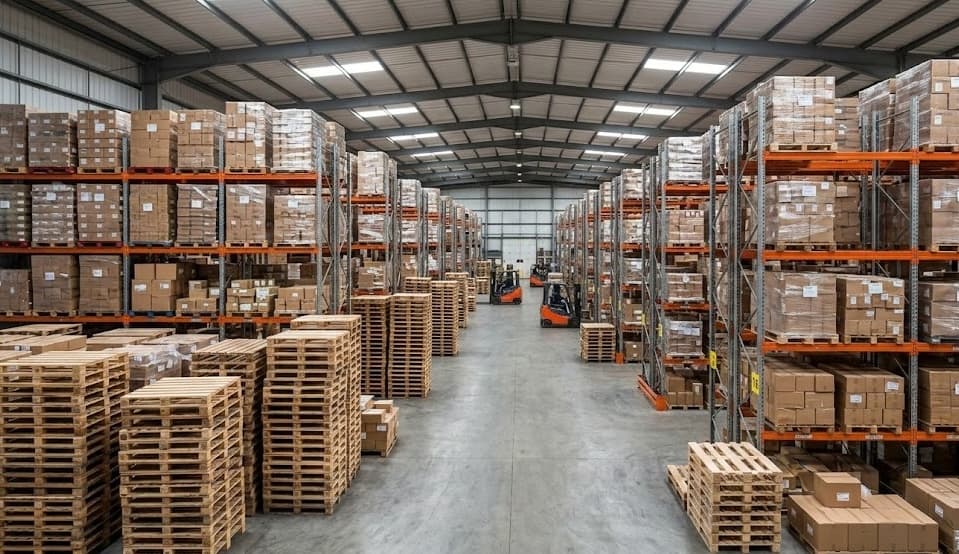
Wood Pallets
The backbone of global shipping. Our recycled wood pallets deliver industrial-grade quality at eco-friendly prices.
Get a Quote Today
Tell us about your pallet needs and we'll get back to you within 24 hours.
Two Construction Types
Wood pallets come in two primary construction types, each with distinct advantages. Understanding the difference helps you choose the right pallet for your specific application.
Why Recycled Wood Pallets?
- 40-60% cheaper than buying new
- Same structural integrity when properly graded
- Reduces deforestation and lumber demand
- Available in all standard and custom sizes
- Heat treatment available for export compliance
- Can be recycled 4-7 times before end of life
Popular Sizes
| Size | Name | Common Uses | |
|---|---|---|---|
| 48" x 40" | GMA Standard | Grocery, retail, general freight | Most Popular |
| 42" x 42" | Telecom / Paint | Drums, telecommunications, paint | |
| 48" x 48" | Square | Drums, bulk containers, automotive | |
| 48" x 42" | Military / Automotive | Chemical, military, automotive | |
| 40" x 40" | Dairy | Dairy products, square loads | |
| 48" x 36" | Beverage | Beverage, bottling, canning |
Where Our Wood Comes From
Roughly 80% of the lumber we use is recycled wood sourced directly from local businesses across the greater Anaheim and Orange County area. Pallets that have completed their initial shipping cycle are collected, inspected, sorted by grade, and either repaired or dismantled for quality boards. This closed-loop approach keeps usable wood out of landfills while providing our customers with affordable, proven material.
The remaining supply comes from sustainable timber partners — domestic mills that follow responsible forestry practices aligned with FSC guidelines. Every board, whether recycled or new, is evaluated against the same structural standards before it enters our production line. The result is a reliable pallet that meets load requirements regardless of its origin.
Recycled Pallets
Collected through local pickups from warehouses, manufacturers, and distribution centers across Southern California. Each pallet is sorted and graded before reuse.
Sustainable Timber
Sourced from domestic mills that practice FSC-adjacent forestry management. New lumber is used when recycled stock cannot meet volume or specification requirements.
Salvaged Lumber
Boards recovered from deconstructed pallets that are no longer repairable as whole units. Quality lumber is extracted, trimmed, and reused in new pallet builds.
Treatment & Compliance
Depending on where your pallets are headed, different treatments may be required. Here are the four options we offer at our Anaheim facility.
Heat Treatment
Wood is heated to a core temperature of 56 °C and held for a minimum of 30 minutes. This is the internationally recognized standard for phytosanitary treatment of wood packaging.
When to choose: Required for all international export shipments.
Kiln Drying
Pallets are dried in a controlled kiln environment to reduce moisture content to below 19%. This prevents mold growth, reduces weight, and improves dimensional stability.
When to choose: Ideal for food, pharmaceutical, or moisture-sensitive cargo.
Chemical Treatment
Methyl bromide fumigation was once standard for pest control in wood packaging. Note: this treatment is being phased out globally due to ozone-depletion concerns.
When to choose: Legacy requirement — check if your destination still accepts MB-treated wood.
No Treatment
Untreated pallets are perfectly suitable for domestic shipments within the United States. No phytosanitary stamp is needed when goods stay within national borders.
When to choose: Choose this for all domestic-only shipping to save cost.
Expected Lifespan by Grade
Pallet longevity depends on grade, load weight, handling conditions, and whether repairs are performed between cycles. Below are conservative estimates for standard warehouse-to-truck use.
| Grade | Estimated Years | Typical Trips |
|---|---|---|
| Grade A | 5–7 years | 6–8 trips |
| Grade B | 3–5 years | 4–6 trips |
| Grade C | 1–3 years | 2–4 trips |
Repair Extends Life
A single repair — replacing cracked deck boards or broken stringers — can add 2–3 additional shipping cycles to any grade, at a fraction of the replacement cost.
Low-Intensity Use
Properly maintained pallets used in low-intensity environments — such as static storage or light warehouse racking — can remain serviceable for 10+ years.
Standards & Certifications
Our wood pallets are built and treated in accordance with the industry standards that matter most to supply-chain professionals.
International Standards for Phytosanitary Measures
The global framework governing wood packaging material in international trade. Ensures pallets are treated to prevent the spread of invasive pests across borders.
National Wooden Pallet & Container Association
The largest organization representing the wood packaging industry in North America. Sets voluntary quality and safety benchmarks for pallet manufacturers.
Grocery Manufacturers Association
Defines the ubiquitous 48 × 40-inch pallet footprint used by grocery retailers and consumer-goods companies nationwide.
Pallet Pooling Compatibility
Our pallets are sized and constructed to be compatible with CHEP and PECO pooling systems, making it easy to integrate into existing supply-chain programs.
Wood Species We Use
Different species offer different trade-offs between strength, weight, cost, and availability. Here are the three categories you will encounter in our inventory.
Southern Yellow Pine
Strong, Affordable, Fast-Growing
The most common softwood used in pallet manufacturing. Southern Yellow Pine offers an excellent strength-to-weight ratio at an economical price point. It grows quickly in managed forests across the southeastern U.S., making it a readily available and renewable resource.
Most common choice for general-purpose pallets.
Oak / Hardwood
Premium Strength, Heavy, Long-Lasting
Oak and other hardwoods deliver superior load-bearing capacity and resistance to impact damage. They are heavier than softwood alternatives, which increases shipping weight but also increases durability. Ideal for heavy machinery, steel coils, and other dense cargo.
Best for heavy-load and long-term storage applications.
Mixed Hardwood
Balanced Strength, Cost-Effective, Recycled
Recycled pallets often contain a blend of hardwood species — maple, birch, poplar, and others. This mixed composition provides a solid balance of strength and affordability, and is the most common makeup of Grade B and Grade C recycled pallets in our yard.
Great strength-to-cost ratio for budget-conscious buyers.