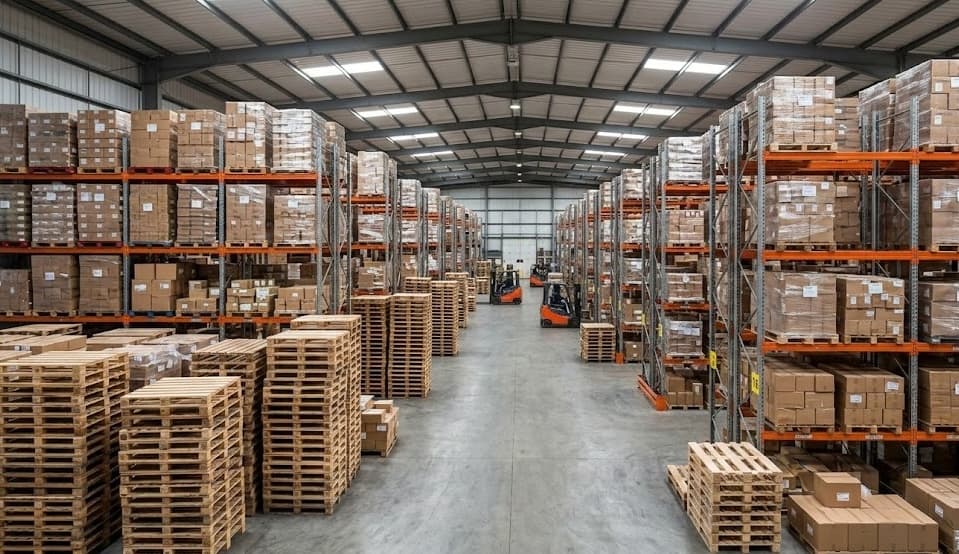
Understanding the Pallet Lifecycle
Every pallet has a story. Understanding its journey helps us make it a longer, greener one.
Get a Quote Today
Tell us about your pallet needs and we'll get back to you within 24 hours.
Raw Materials
New pallets begin as lumber — typically Southern Pine or Oak. Logs are milled into boards and stringers. This stage consumes the most resources: water, energy, and forest land.
Environmental Impact
High — deforestation, energy use, water consumption
Eco Opportunity
Recycled pallets skip this stage entirely, saving 3.5 board feet of lumber per pallet.
Manufacturing
Boards and stringers are cut to size, assembled with nails or staples, and may undergo heat treatment for international shipping compliance (ISPM 15).
Environmental Impact
Moderate — energy, waste from cuts
Eco Opportunity
Recycled pallet preparation uses 80% less energy than new manufacturing.
First Life
The pallet enters service — carrying goods through warehouses, onto trucks, across oceans. A typical pallet makes 3-5 trips before needing attention.
Environmental Impact
Low — the pallet is doing its job
Eco Opportunity
Proper handling extends this stage significantly.
Collection & Sorting
After use, pallets are collected from retailers, warehouses, and distribution centers. They're sorted by condition: reusable, repairable, or recyclable.
Environmental Impact
Low — transportation emissions
Eco Opportunity
Efficient collection routes minimize transportation footprint.
Repair & Refurbishment
Repairable pallets receive new boards, redriven nails, and structural reinforcement. A skilled repair team can bring a Grade C pallet back to Grade A condition.
Environmental Impact
Very Low — minimal materials and energy
Eco Opportunity
Each repair cycle prevents one new pallet from being manufactured.
Multiple Lifecycles
A well-maintained wood pallet can serve 4-7 complete use cycles. Plastic pallets can last 10+ years. Each cycle represents significant resource savings.
Environmental Impact
Cumulative savings multiply with each cycle
Eco Opportunity
By cycle 4, the environmental savings are equivalent to preventing 22+ kg of CO₂.
End of Life & Recovery
When a pallet truly reaches end of life, it's dismantled. Good boards are salvaged. Wood becomes mulch, animal bedding, or biomass fuel. Metal is recycled.
Environmental Impact
Positive — materials return to productive use
Eco Opportunity
98% of materials are recovered and repurposed.
Environmental Impact by Lifecycle Stage
Every stage of a pallet's life carries an environmental cost — or an environmental benefit. The table below breaks down the CO₂ footprint at each phase, comparing what happens when you choose new pallets versus recycled ones.
| Lifecycle Stage | CO₂ per Pallet | Key Drivers |
|---|---|---|
| Raw Material (new pallet) | 33 lbs | Logging, milling, transport of lumber |
| Manufacturing | 8 lbs | Assembly, nailing, equipment operation |
| First Use | ~0 lbs | Transportation footprint belongs to cargo |
| Recycling / Repair | 3 lbs | Collection, sorting, repair labor |
| End of Life (landfill) | 15 lbs | Methane from wood decomposition |
| End of Life (recycled) | -5 lbs | Mulch offsets, material recovery credits |
New Pallet Total
56 lbs CO₂ per pallet
Raw material + manufacturing + landfill disposal
Recycled Pallet Total
3 lbs CO₂ per pallet
94% reduction in carbon footprint
Cost Analysis by Stage
Understanding the economics at every lifecycle stage reveals where money is spent — and where it can be saved. Recycled pallets don't just help the environment; they dramatically reduce your total cost of ownership.
New Pallet Purchase
$12–18
Per pallet, depending on grade and size (48×40 GMA standard)
Recycled Pallet Purchase
$4–8
55–65% savings over new — same structural performance for most uses
Repair Cost
$2–4
Per pallet — extends usable life by 3–5 additional cycles
Disposal Cost
$45–65/ton
California landfill tipping fees — and rising every year
Selling Used Pallets
$1–4
Revenue per pallet — turn a waste stream into an income stream
Net Lifecycle Savings
$480K+
Estimated savings over 5 years for 1,000 pallets/month switching to recycled
5-Year Cost Comparison: 1,000 Pallets/Month
New Pallet Program
- Purchase (60,000 pallets)$900,000
- Disposal costs$78,000
- Resale revenue-$60,000
- Net Cost$918,000
Recycled Pallet Program
- Purchase (60,000 pallets)$360,000
- Repair / reconditioning$72,000
- Disposal costs$6,000
- Net Cost$438,000
Total Savings: $480,000 over 5 years (52% reduction)
Optimization Tips for Each Stage
Getting the most out of every pallet requires intentional decisions at each stage. Here are the practical steps that the most efficient warehouse and logistics operations follow.
Procurement: Buy the Right Grade
Don't overspend on Grade A pallets for one-way shipping. Match the pallet grade to the job — Grade B recycled pallets handle most domestic freight perfectly. Reserve premium grades for export or high-value goods.
In Use: Train Your Forklift Operators
Improper forklift handling is the #1 cause of pallet damage. Training operators on correct entry, lifting, and stacking techniques reduces pallet breakage by up to 40% — saving thousands per year in replacement costs.
Storage: Stack Properly
Empty pallets should be stacked no more than 15 high, on level ground, away from moisture. Uneven stacking warps boards and weakens stringers, shortening pallet life before it even begins its next cycle.
Return: Implement a Pallet Return Program
Every pallet that leaves your facility and never comes back is lost value. Work with your customers and carriers to establish a return system. Even a 50% return rate can cut your annual pallet spend by 30%.
Recycling: Partner with a Local Recycler
A dedicated pallet recycler handles pickup, sorting, and processing — removing the burden from your team. Look for partners who offer scheduled pickups and transparent grading so you know exactly what you're getting back.
End of Life: Grind, Don't Landfill
When a pallet is truly beyond repair, ensure it's ground into mulch or biomass rather than sent to a landfill. Grinding recovers value, avoids tipping fees, and prevents methane emissions from decomposing wood.
The Infinite Loop: Closed-Loop Pallet Systems
The ultimate pallet lifecycle isn't a line — it's a circle. A closed-loop pallet system eliminates waste entirely by keeping pallets cycling between you and your recycling partner indefinitely. Here's how it works.
You Buy Recycled Pallets
Inspected, graded, and delivery-ready
Ship Your Products
Pallets carry your goods to customers
Customer Returns Pallets
Pickups coordinated by us
We Sort, Inspect & Repair
Every pallet graded and restored
Back to You
The loop continues — zero waste
Benefits of a Closed-Loop System
- ✓Predictable, stable pallet costs — no market volatility surprises
- ✓Zero waste sent to landfill from your pallet operations
- ✓Simplified procurement — one partner, one agreement, one invoice
- ✓Trackable sustainability metrics for ESG and compliance reporting
Getting Started
- Minimum Volume200 pallets/month
- Agreement Term1-year commitment
- Sustainability ReportsQuarterly, included at no extra cost
- Setup TimeTypically 2–3 weeks from agreement