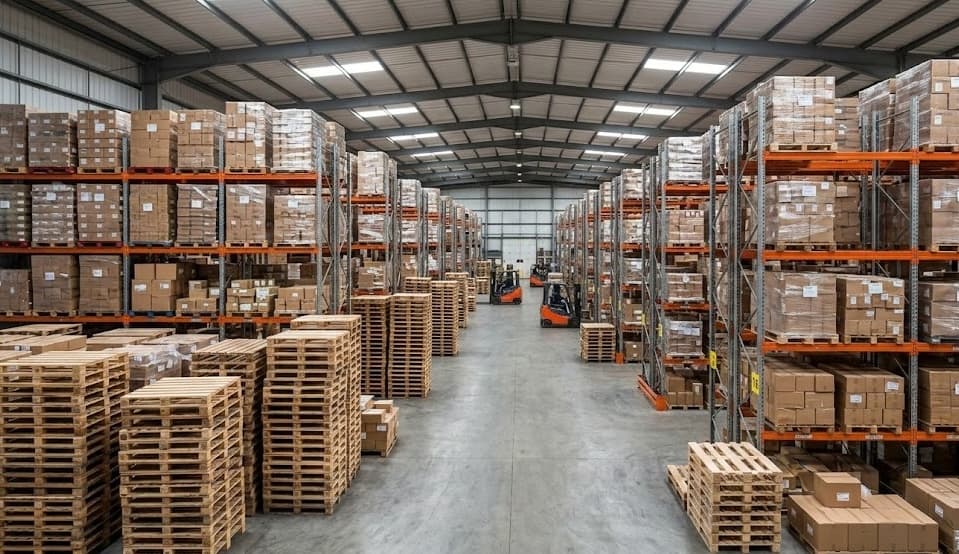
If you've ever walked into a warehouse, driven past a loading dock, or received a shipment at your business, you've seen pallets. But most people never think about them. That's a mistake — because pallets are the silent backbone of global trade.
A pallet is a flat, portable platform used to stack, store, and transport goods. Forklifts, pallet jacks, and cranes all interface with pallets, making them the universal connector between products and the machines that move them. Without pallets, modern logistics would grind to a halt — literally everything from the food on grocery shelves to the electronics in your pocket traveled on a pallet at some point.
An estimated 80% of all goods in the United States travel on pallets at some point in their journey from manufacturer to consumer. There are roughly 2 billion pallets in circulation in the US alone — more than six pallets for every person in the country. It's an industry that generates over $30 billion in annual revenue, yet remains almost entirely invisible to the average person.
The history of the pallet dates back to the early 20th century. The modern pallet as we know it emerged in the 1920s alongside the development of the forklift. During World War II, the US military standardized pallet dimensions to streamline supply chains across theaters of war. That military standard eventually became the 48×40 inch GMA pallet that dominates North American logistics today.
Pallets come in many sizes, materials, and construction types. The most common in North America is the 48×40 inch wooden pallet, also known as the GMA pallet. But plastic, metal, and even cardboard pallets serve specialized roles. Each material has its own strengths: wood is affordable and repairable, plastic is hygienic and consistent, metal is virtually indestructible, and cardboard is lightweight for single-use export.
Construction styles matter too. Stringer pallets use long boards running parallel to the deck for support and are the most common in North America. Block pallets use solid wood blocks and offer true four-way forklift access, making them the international standard. The choice between them depends on your handling equipment, load requirements, and shipping destinations.
Pallet quality is graded on a scale from A (like new) to D (recycling only). Understanding these grades is critical for purchasing — a Grade A recycled pallet performs identically to a new one at a fraction of the cost, while a Grade C pallet may be perfectly adequate for one-way shipments where appearance doesn't matter.
The environmental dimension of pallets is often overlooked. Manufacturing a single new wood pallet requires approximately 12 board feet of lumber. With 500 million new pallets produced annually in the US, that's a significant demand on forestry resources. Recycling pallets — reusing, repairing, and repurposing them — dramatically reduces this demand.
Why does this matter for your business? Because the pallets you choose affect your shipping costs, product safety, warehouse efficiency, and environmental impact. Choosing wisely — and choosing recycled — can make a meaningful difference on all fronts.
At Anaheim Eco Pallets, we believe that understanding pallets is the first step toward making better choices. Whether you're new to the industry or a seasoned logistics professional, the fundamentals of pallet selection, maintenance, and recycling can unlock significant savings and sustainability benefits for your operation.