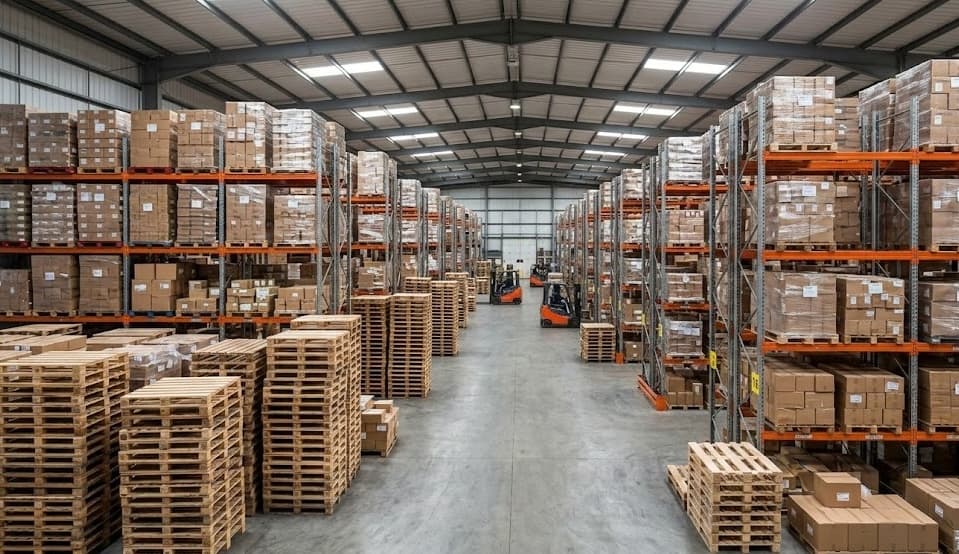
The pallet industry, long considered a low-tech sector, is undergoing a quiet technological revolution. Automation is improving efficiency, quality, and sustainability across the entire pallet lifecycle — from manufacturing and repair to tracking and end-of-life processing.
Automated sorting systems use sensors, cameras, and increasingly AI-driven image recognition to classify pallets by size, type, and condition in seconds. What once required experienced human sorters working at the pace of human judgment can now be done faster and more consistently by machine. These systems can evaluate structural integrity, identify damage patterns, and grade pallets with accuracy rates exceeding 95%.
Robotic nail drivers and board replacement machines are making pallet repair faster and more precise. A single automated repair line can process 3-4 times the volume of a manual crew, with higher consistency. The robots don't get tired, don't have bad days, and drive every nail at the same depth and angle.
Computer vision for quality control is perhaps the most impactful automation advance. High-resolution cameras and machine learning algorithms can detect hairline cracks, early-stage rot, and structural weaknesses that even experienced human inspectors might miss. This technology catches problems before they become failures, improving safety and customer satisfaction.
RFID and IoT tracking are enabling real-time pallet management. Companies can now track individual pallets through the supply chain, optimize rotation, and identify loss points — something impossible with untracked pallets. RFID tags cost as little as $0.15 each, making fleet-wide tracking economically viable for the first time.
GPS-enabled fleet management has transformed collection logistics. Optimized routing algorithms reduce fuel consumption, empty miles, and driver hours. Our collection trucks cover 30% more stops per day than they did five years ago, thanks to route optimization software that adjusts in real time based on traffic, pickup volumes, and truck capacity.
Data analytics is revealing patterns that were invisible before automation. By tracking millions of data points — pallet types, damage patterns, customer volumes, seasonal trends — we can predict demand, optimize inventory, and identify operational improvements. Data-driven decision-making is replacing the intuition-based management that traditionally characterized the industry.
For recyclers like us, automation means we can process more pallets with higher quality standards while keeping costs competitive. Our investment in automated equipment has directly translated into better prices and faster turnaround for our customers. It's a win-win enabled by technology.
For pallet users, automation means more reliable supply, more consistent quality, and better tracking capabilities. The pallets you receive from a modern automated facility are graded more accurately and inspected more thoroughly than was possible with purely manual processes.
The future of the pallet industry is a blend of skilled human judgment and automated precision. Humans handle the nuanced decisions — customer relationships, complex repairs, creative problem-solving. Machines handle the repetitive, precise, data-intensive work. Together, they serve the same goal we've always had: keeping pallets in circulation and out of landfills.