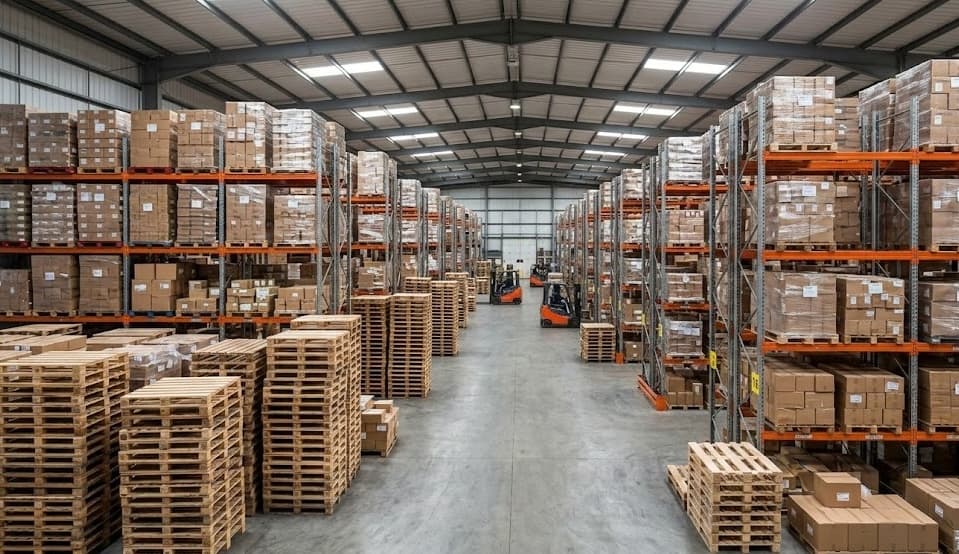
Pallet recycling sounds simple in theory: take old pallets, make them useful again. But the reality involves a sophisticated multi-step process that maximizes value from every piece of wood and metal. Let us walk you through what actually happens from the moment we pick up your used pallets to the moment they re-enter the supply chain.
Step one is collection. Our trucks run daily routes throughout Southern California, picking up used pallets from warehouses, retail locations, and distribution centers. Efficient routing means we minimize fuel use while maximizing pickup volume. We use GPS-optimized route planning that adjusts in real-time based on volume at each location, reducing empty miles by approximately 30% compared to static routing.
At our facility, incoming pallets are unloaded and immediately sorted. Experienced sorters evaluate each pallet in seconds, directing it to one of four streams: direct reuse (Grade A), repair (Grade B-C), dismantle for parts, or grind for material recovery. This triage decision is critical — it determines the highest-value path for each individual pallet.
Direct reuse pallets — Grade A — require only a quick inspection and cleaning. These pallets show minimal wear and meet full structural standards. They go through a brief quality check, are restacked in uniform lots, and are ready for immediate resale. Approximately 25-30% of incoming pallets qualify for direct reuse.
The repair line is where the magic happens. Skilled technicians replace broken boards, reinforce weak points, re-drive nails, and bring damaged pallets back to full working condition. A good repair tech can process 80-100 pallets per shift. The key skill is judgment — knowing exactly which boards to replace and which are still sound. Over-repairing wastes time and materials; under-repairing sends out a substandard product.
Our repair stock comes from dismantled pallets. Pallets that are too damaged to repair economically are carefully taken apart by hand. Good boards — straight, uncracked, and dimensionally accurate — are sorted by size and stored as repair inventory. This internal supply of used boards means we can repair pallets at a fraction of what new lumber would cost.
Pallets that can't be repaired are dismantled. Good boards are salvaged as repair stock. The remaining wood goes through our industrial grinder, producing chips that become mulch, animal bedding, or biomass fuel. Our grinder can process up to 200 pallets per hour, turning what would be landfill waste into commercially valuable products.
The grinding operation produces several grades of material. Coarse chips become landscape mulch. Fine chips and sawdust go to animal bedding suppliers. The smallest particles are compressed into fuel pellets for biomass energy generation. Each product stream has its own market and pricing.
Even the nails aren't wasted — they're collected by magnetic separators and sent to steel recyclers. Pallet nails are made from high-carbon steel, which has strong recycling value. At the end of the process, 98% of all incoming material has been given a productive second life.
Quality control runs throughout the entire process. Every repaired pallet is load-tested and inspected before it leaves our facility. We stand behind our grading with a replacement guarantee — if a pallet doesn't perform to its stated grade, we replace it at no charge. This commitment to quality is what keeps our customers coming back.
The entire operation is designed around one principle: there is no such thing as pallet waste, only material that hasn't found its best use yet. Every piece of wood, every nail, every fragment has value if you're systematic about capturing it.